
Strategies for Response to Climate Change
Climate Change Response Promotion System
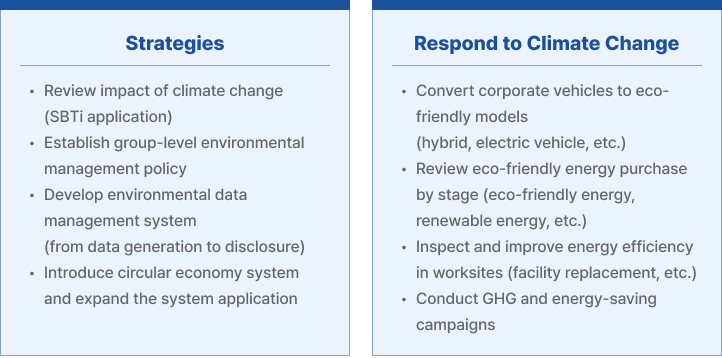
Daejoo Electronic Materials recognizes response to climate change as the top-priority task. For climate change response, we have established a group-level environmental management policy and an environmental data management system as short-term measures, and we plan to review the long-term impact of climate change. In addition, we plan to carry out detailed GHG reduction activities including energy saving campaign, energy efficiency improvement in worksites, and review of eco-friendly energy purchase.
Effort for GHG Reduction
Management of GHG Emissions
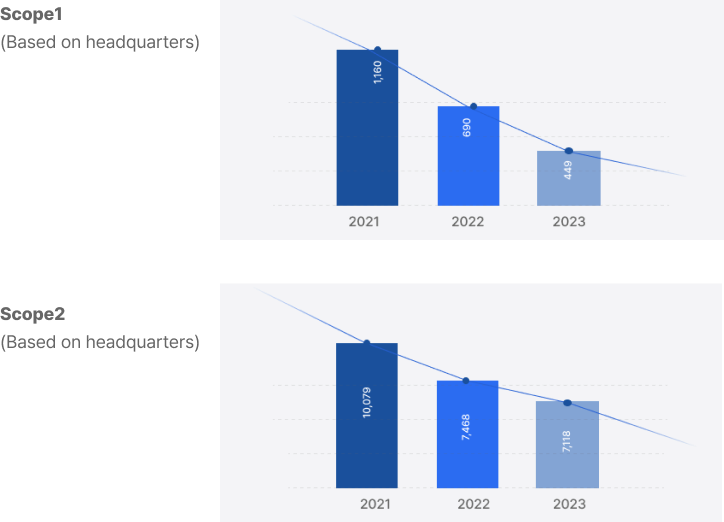
For climate change response, Daejoo Electronic Materials is managing indicators such as the amount of GHG emissions, fluctuations in Scope 1 and Scope 2 emissions, GHG intensity, and energy consumption. Each year, we analyze the factors causing fluctuations in energy consumption and prepare improvement plans for increased emissions as part of our effort for GHG reduction.
As a result of our effort for GHG reduction, Scope 1 and Scope 2 GHG emissions from the headquarters and plant have continuously decreased in the past three years. As for our Battery Campus plants, the amount of emissions is increasing in line with the ongoing mass production line extensions.
Energy Management Activities
Daejoo Electronic Materials continuously manages energy consumption and strives to improve energy efficiency. In October 2021, we replaced two of the existing non-inverter-type 50HP air compressors with inverter-type 50HP air compressors. While the electric power consumption of the previous air compressor model was 25.7kW, that of the new model decreased to 16.4kW. As a result of the replacement of old equipment, our energy reduction amount increased from 27MWh in 2021 to 161MWh in 2023.
Joint Photovoltaic R&D Center
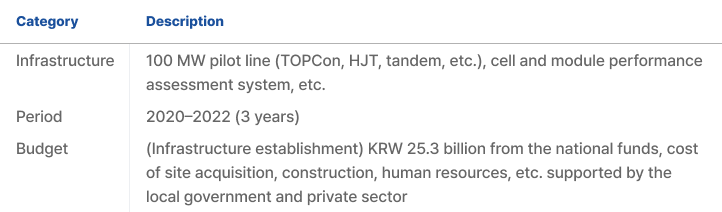
In 2020, Daejoo Electronic Materials entered into an MOU with photovoltaic material, component, and equipment companies such as LG Electronics, HD Hyundai Energy Solutions, Shinsung E&G and Jusung Engineering, as well as the Korean Energy Technology Evaluation and Planning for the joint use of research center by photovoltaic companies. The photovoltaic research center is equipped with a 100MW pilot line through which the processes, performances, etc. of products developed through R&D by the companies can be verified in the pre-mass production stage. Having devised cooperation plans to lead the global photovoltaic market, we laid the foundation for domestic photovoltaic cell, module, and material as well as component and equipment manufacturers to promote joint technological development based on cooperation.
Promotion to Achieve Smart Hub RE100
In 2021, Daejoo Electronic Materials entered into a business agreement with the Gyeonggi Regional Headquarters of Korea Industrial Complex Corporation, Korea RE100 Committee, Smart Energy Platform Cooperative, and companies of the Banwol Sihwa Industrial Complex for the promotion of cooperation to achieve smart hub RE100.
This agreement is aimed at spreading carbon neutrality and energy independence among tenant companies of the Banwol Sihwa Industrial Complex through cooperation to achieve RE100. Based on this agreement, Daejoo Electronic Materials is striving to achieve RE100 while minimizing the required cost for attaining this goal.
*Smart Energy Platform Cooperative: Consisting of 127 SMEs located in the Banwol and Sihwa areas as members, this cooperative was established based on the Mini Cluster—an industry-university-research sector network of Korea Industrial Complex Corporation to support SMEs—and is equipped with excellent technologies for energy efficiency improvement and reduction of carbon emissions.
*Korea RE100 Committee: Launched in 2019, this committee with approximately 20 members who are energy and climate change experts from the Korean Society for New and Renewable Energy supports the voluntary participation of domestic enterprises in the fulfillment of RE100.
Eco-friendly Vehicle
To promote the use of green energy, Daejoo Electronic Materials set the conversion of 50% of corporate vehicles into eco-friendly models by 2030 as a goal. As of 2023, 2 of our 31 corporate vehicles in all are eco-friendly models, and we continue exerting effort to create the environment for promoting conversion into eco-friendly vehicles.